Intro
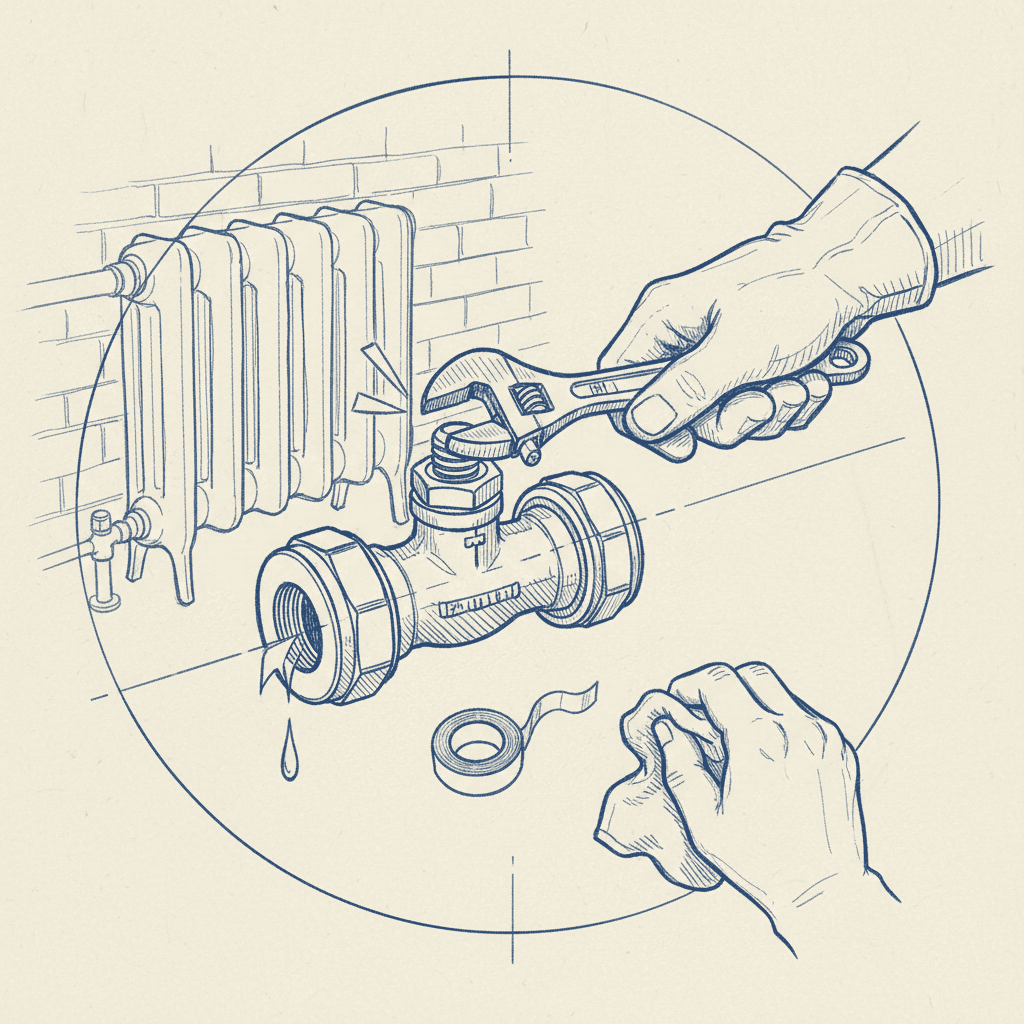
On most jobs, fixing a leaking radiator valve is quick money if you do it right. The leak usually comes from the gland, the union, or the valve tail. In this guide, you’ll learn simple checks, safe isolation, and step-by-step repairs. We’ll cover the tools, parts, and the little tricks that stop callbacks. You’ll also see how to price and document small valve jobs without fuss. Do these steps and you’ll leave every radiator dry, pressurised, and ready.
Quick Answer
Fixing a leaking radiator valve starts with turning the system off and cooling it. Identify the leak point, then tighten the gland 1/8–1/4 turn, or reseal the union with a new olive and PTFE. Re-pressurise to 1.0–1.5 bar, bleed, and test for 10–15 minutes. Replace the valve if the body is cracked.
Table of Contents
Key Takeaways
- Most leaks are gland or union issues; full swaps take 45–90 minutes.
- Tighten glands gently (1/8–1/4 turn). Don’t overdo it.
- Re-pressurise sealed systems cold to 1.0–1.5 bar.
- Use 10–12 PTFE wraps on tails; replace olives if pitted.
- Test at operating temp for 10–15 minutes before leaving.
Fixing a Leaking Radiator Valve: Safety And Diagnosis
A radiator can sit at 60–75°C. Don’t touch hot pipework. Turn the boiler off and let the system cool for 20–30 minutes. Place towels and a 5‑litre bucket under the valve.
Check where the water comes from:
- From the spindle under the cap? That’s the gland.
- From the large nut to the radiator? That’s the union.
- From the tail into the radiator? Tail or olive issue.
- From the valve body? Replace the valve.
Look for green staining, white crust, or a water line. Run a tissue around joints to spot slow weeps. Confirm TRV heads are working and the pin moves freely 2–4 mm.
Bring the right kit and you’ll finish in one visit.
- Adjustable spanners (200–250 mm) and 13/17/22 mm spanners
- PTFE tape (10–12 wraps for tails), jointing compound, silicone grease
- Replacement 15 mm olives and 1/2" BSP valve tails
- Radiator bleed key and hex/Allen key for some tails
- Olive puller (saves pipes and time), mini pipe cutter, deburrer
- Leak detection spray or soapy water, microfibre cloths
- Inhibitor (250–500 ml) for top-up on sealed systems
Tip: Pre-wrap a few tails with PTFE on the bench. It saves 5–10 minutes on site.
Fixing a Leaking Radiator Valve: Step-By-Step Repair
Use these steps for most small leaks. Adjust as needed on site.
- Isolate And Cool
- Turn off the boiler. Close the TRV/wheelhead and the lockshield. Count and note lockshield turns (e.g., 1.5 turns) for re‑set.
- Depressurise
- For sealed systems, drop pressure to 0 bar at a drain point. For open‑vented, isolate feed if needed and be ready with a bucket.
- Diagnose Precisely
- Dry the valve fully. Wrap tissue around the gland and union. Open slightly to see where it wets first.
- Gland Tighten (Minor Weep)
- Remove TRV cap if needed. Nip the small gland nut 1/8–1/4 turn. If it still weeps, back off, add a few turns of PTFE string under the cap, and retighten.
- Union Reseal (Common Fix)
- Crack the union nut to the radiator. Catch 1–3 litres of water. Pull back gently. Inspect the olive and seat. Replace the olive if pitted or oval. Light smear of compound on threads/olive. Refit and tighten snug, then a further 1/8–1/4 turn.
- Tail Reseal (If The Tail Leaks)
- Remove the radiator tail with the correct hex key. Clean threads. Wrap 10–12 PTFE turns neat and tight, from thread start to 2–3 threads from the end. Refit firmly.
- Full Valve Swap (If Cracked Or Seized)
- Drain the radiator fully. Cut back to clean copper if needed. Fit the new valve, new olive, and tail. Keep the valve straight. Tighten both sides evenly.
- Reopen And Refill
- Open the lockshield to the noted position. Open the TRV/wheelhead. Refill the system. Add inhibitor if you drained more than 5 litres.
- Bleed Radiator
- Bleed until water runs solid. Top up sealed system to 1.0–1.5 bar when cold.
- Test And Inspect
- Run the heating until the radiator is hot. Check the gland, union, and tail for 10–15 minutes. Use leak spray. Wipe dry and recheck.
Time guide:
- Gland nip/repack: 10–20 minutes.
- Union reseal: 30–45 minutes.
- Full valve swap: 45–90 minutes.
Pressure, Bleeding, And Testing
On sealed systems, set pressure to 1.0–1.5 bar cold. Large homes may sit nearer 1.5 bar. After bleeding, pressure drops. Top up slowly. Don’t overshoot.
Open lockshields to the original setting. If you forgot the count, crack it open 1 turn and balance later. Bleed again once hot. Many contractors find a second bleed after 10 minutes catches trapped air.
Always test at temperature. Heat thins water. Small weeps can show only when hot. Leave a tissue collar around the union while testing. If it stays dry for 10–15 minutes, you’re good.
Pricing, Paperwork, And Preventing Callbacks
Small leaks turn into great repeat work when you show care.
- Upfront price bands: minor nip £60–£90; reseal £90–£150; full swap £150–£250+. Adjust for access and region.
- Add materials: valve (£12–£35), olives, PTFE, compound, inhibitor (£10–£20 share).
- Note pre-set lockshield turns on your job sheet. It proves you preserved balance.
- Take 3 photos: before, open joint, final test. They save disputes.
On site, dictate job notes and parts used, then create a tidy proposal before you leave. Tools like Donizo let you capture voice, text, and photos, turn them into a branded proposal, and get an e‑signature fast. Then convert it to an invoice in one click. If you’re also looking to streamline professional proposals, invoice templates, and pricing strategies, build simple internal guides your team can follow.
Common Mistakes And How To Avoid Them
- Over‑tightening the gland: You’ll stiffen the spindle or crack the nut. Go 1/8–1/4 turn only.
- Reusing a scored olive: It will leak again. Replace it.
- PTFE in clumps: Wrap tails tight, even, and in one direction, 10–12 neat wraps.
- Forgetting the lockshield position: Always count turns. Write it down.
- Skipping hot test: Cold joints can pass; hot joints can weep. Always test hot.
- Mixing thread standards: Most radiator tails are 1/2" BSP. Check parts before you commit.
For contractors dealing with project timelines, keep a simple checklist for radiator tasks. This pairs well with understanding change orders and clear scope notes, so you avoid unpaid extras later.
Frequently Asked Questions
How can I tell if it’s the gland or the union leaking?
Dry the valve, then wrap tissue around the gland and the union separately. Open the valve slightly. If the tissue by the spindle gets wet first, it’s the gland. If the tissue on the large nut to the radiator gets wet, it’s the union.
How many PTFE wraps should I use on a radiator tail?
Use 10–12 tight, even wraps. Start 1 thread back from the end. Keep the tape flat. Press it into the threads as you turn. Too few wraps can weep. Too many can split or bunch.
What pressure should a sealed system be after the repair?
Set it cold to 1.0–1.5 bar. Many homes are fine at around 1.2 bar. After bleeding, top it up again. Recheck after the system heats and cools once.
When should I replace the whole valve instead of repairing?
Replace the valve if the body is cracked, badly corroded, or the spindle is seized. Also replace if a TRV pin won’t move freely after cleaning and lubricating, or if the union seat is badly damaged.
Do I need to add inhibitor after draining a radiator?
If you’ve drained more than a few litres, top up inhibitor. It helps prevent sludge and corrosion. Many contractors add 250–500 ml after repairs on sealed systems. Follow the product label.
Conclusion
Fixing a leaking radiator valve is simple when you follow a clear process: isolate, diagnose, reseal or replace, then re‑pressurise and test hot. Note lockshield turns, replace tired olives, and wrap PTFE neatly. Next steps: 1) Build a basic valve repair checklist, 2) Pre-stock olives, tails, and valves, 3) Take before/after photos on every job. For tidy paperwork on small repairs, platforms such as Donizo help you record details by voice, send a branded proposal, collect an e‑signature, and invoice fast. Do the small jobs well and they turn into steady, repeat work.