Intro
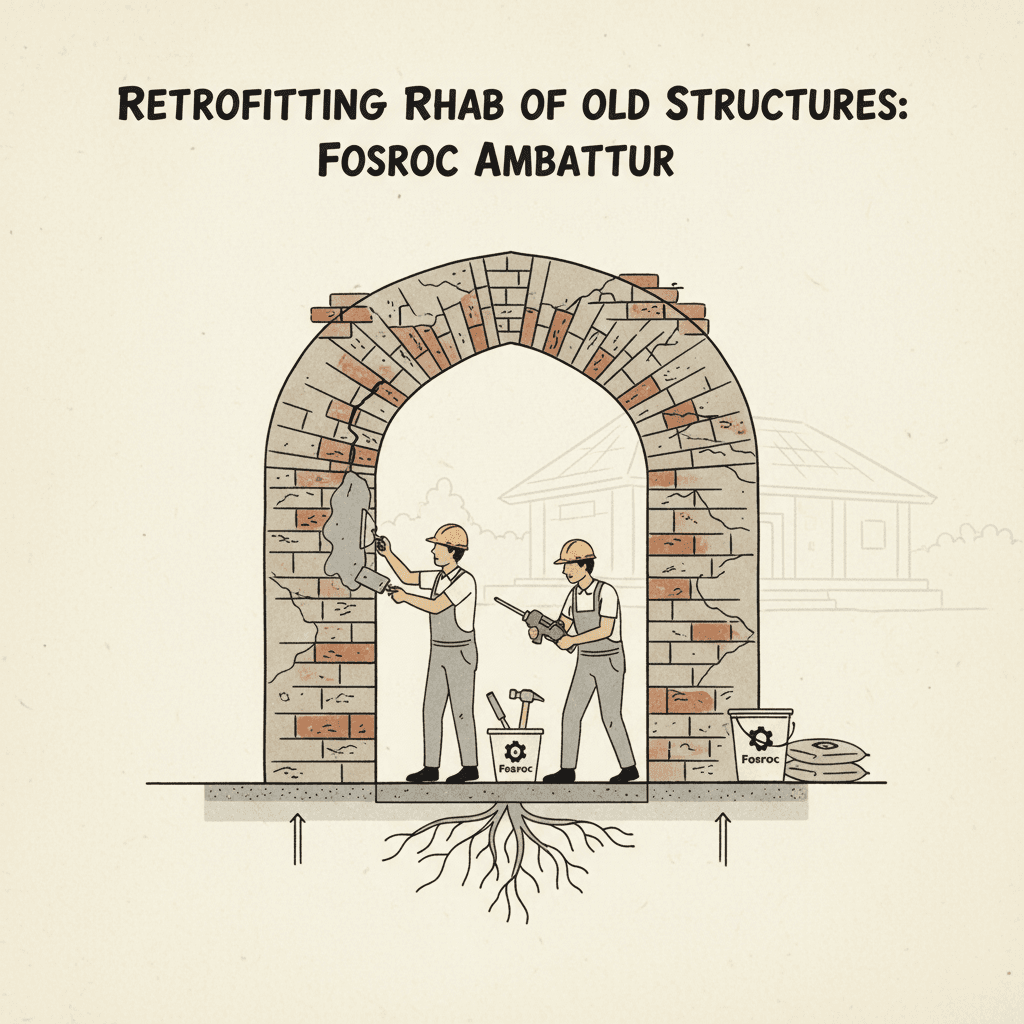
On most jobs in Ambattur, you see the same problems. Cracks, rusted rebar, leaks, and weak concrete. Retrofitting and rehabilitation of old structures Fosroc Ambattur building repairs is about fixing those issues safely and fast. This guide shows you what to check, how to plan, and which Fosroc systems fit common defects. You’ll get simple steps, real timelines, and numbers you can use on site. Follow this, and your repairs will last longer and pass inspection the first time.
Quick Answer
Retrofitting and rehabilitation of old structures in Ambattur means assessing damage, choosing the right Fosroc repair system, and executing with strong QC. Start with a survey and tests, then repair concrete, protect rebar, and strengthen members where needed. Plan 2-6 weeks for medium jobs, depending on scope and curing.
Table of Contents
Key Takeaways
- Do a structured survey first. Plan 1-3 days for a small block.
- Choose systems by defect, not brand alone. Crack size drives method.
- Typical patch depth is 10-50 mm. Cure at least 7 days.
- Strengthening often needs anchors or CFRP. Expect 1-3 layers for wraps.
- Medium jobs finish in 4-6 weeks with clear phasing and night shifts.
Retrofitting And Rehabilitation Of Old Structures: Ambattur Basics
Ambattur is hot, humid, and near the coast. Chlorides and moisture attack concrete and steel. Old industrial buildings also see vibration and chemicals. That’s why retrofitting and rehabilitation of old structures Fosroc Ambattur building repairs must start with a good survey.
What To Check First
- Visual map of cracks, spalls, leaks, and rust stains
- Hammer tap to find hollows and delamination
- Rebar cover check (typical target 25-40 mm in many slabs)
- Simple tests: rebound hammer, carbonation depth, chloride screening
- If needed, cores for compressive strength (common aims: 20-40 MPa)
Write it all down with photos and grid references. Mark urgent risks like loose cover or exposed bars.
Repair And Retrofit Plan: Scope, Design, Budget
Retrofitting and rehabilitation of old structures works best with a tight plan. No guesswork. No jumping steps.
1) Define The Objective
- Stop water, stop corrosion, restore strength, or increase capacity?
- For seismic/strength upgrades, consult a structural engineer. Use local codes and accepted guidelines for evaluation and design.
2) Choose The Method
- Patch repair for small spalls (10-50 mm)
- Large voids with micro-concrete pour or flowable grout (50-150 mm)
- Crack injection for structural cracks ≥0.2 mm
- Jacketing or CFRP wraps for columns and beams
- Anchor plates or dowels for load paths
3) Sequence And Time
- Survey and tests: 1-3 days
- Trial area/mock-up: 2-4 days
- Main repair: 2-5 weeks for mid-size blocks
- Curing and QC: 7-14 days
4) Budget Notes Contractors Care About
- Materials are 25-40% of cost on many repairs
- Access and surface prep often eat 30-50% of labor time
- Night shifts add 10-20% but reduce client downtime
This structure keeps you on schedule and protects your margin. If you also want to streamline professional proposals and change handling, plan to link to resources on creating professional proposals, managing project timelines, and change order best practices.
Fosroc Ambattur Building Repairs: Material Choices
Use systems, not single products. Pick by defect, depth, and strength needs. In Ambattur, think about high temperature (32-40°C), fast set, and chloride resistance.
Typical Fosroc System Selection
- Patch Repair: Polymer-modified mortars with 25-60 MPa compressive strength. Good for 10-50 mm depth. Use a compatible bonding agent where the spec calls for it.
- Larger Recasts: Micro-concretes or flowable repair grouts. Target low shrinkage. Ideal for 50-150 mm encasements and jacketing.
- Crack Injection: Low-viscosity epoxy for 0.2-0.5 mm structural cracks. For wider cracks (>1.0 mm), stitch or route-and-seal as needed.
- Rebar Protection: Anti-corrosion primers and cementitious coatings. Clean steel to bright metal before coating.
- Anchors And Dowels: Two-part resin anchor systems. Common embedment is 8-12 bar diameters, per design.
- Strengthening: CFRP wraps or plates. Often 1-3 layers, depending on design demand.
- Waterproofing: Cementitious or epoxy systems for wet areas, sumps, and terraces. Salt-resistant choices matter near the coast.
This is the backbone of retrofitting and rehabilitation of old structures Fosroc Ambattur building repairs. Match the system to the job cards and test results.
Execution: Step-By-Step Methods That Work
Keep steps simple and repeatable. Train your crew. Supervise key stages.
1) Surface Prep (Don’t Skip This)
- Mark repair boundaries and saw-cut edges 10-15 mm deep.
- Break out all weak concrete to sound substrate. Feather edges fail.
- Expose corroded bars at least 20-30 mm behind rust line.
- Grit blast or wire-brush steel to bright metal. Blow off dust.
- Check substrate pull-off. Aim for ≥1.5 MPa where specified.
2) Steel Treatment And Bonding
- Apply anti-corrosion primer to cleaned steel per datasheet.
- Use a bonding agent if the repair mortar requires it. Keep tacky where directed.
3) Patch Repair Or Recast
- Pre-wet the substrate to SSD (surface saturated, no standing water).
- Place repair mortar in lifts if depth >30-40 mm.
- Compact well. Avoid air pockets. Trowel finish as specified.
- For larger areas, use form-and-pour micro-concrete or grout. Seal forms tight.
4) Crack Injection
- Identify structural vs. non-structural cracks.
- Seal the surface with epoxy paste. Fix ports at 150-300 mm centers.
- Inject low-viscosity resin from bottom up until refusal.
- After cure, remove ports and grind flush.
5) Strengthening (CFRP Or Jacketing)
- Prepare surface to the required profile (clean, even, dry as specified).
- Prime, apply epoxy saturant, then install CFRP fabric or plates.
- Roll out bubbles. Maintain overlap lengths per design.
- For RC jacketing, fix shear connectors, tie cages, and pour 50-100 mm jacket.
6) Curing And Protection
- Start curing immediately. Keep moist for 7 days, or use curing compounds.
- Protect from heat, wind, and rain. High Ambattur heat speeds drying.
- Do not load members early. Follow 3, 7, and 28-day strength checkpoints.
These steps anchor retrofitting and rehabilitation of old structures Fosroc Ambattur building repairs to solid, repeatable field practice.
Quality Control, Safety, And Handover
Strong QC means fewer callbacks.
QC Checks That Matter
- Substrate pull-off: ≥1.5 MPa where required by spec
- Repair mortar cubes: track 3, 7, 28-day strengths
- Rebar cover after repair: confirm 25-40 mm or as per design
- Crack injection proof: no re-leaks after 48-72 hours
- Visuals: no honeycombing, good edges, correct finish
Safety And Stability
- Shore beams and slabs when breaking out near supports
- Control dust and silica with wet methods and PPE
- Lockout-tagout near live electrical or process lines in plants
Handover Pack
- Before/after photos and marked drawings
- Material batch records and test results
- Maintenance notes: recoat or seal intervals (often 5-10 years)
Pricing, Proposals, And Client Buy-In
Clients say yes when they see clear scope, methods, and timelines. Keep it simple.
- Show problem photos and mark defect types. Add 2-3 method drawings.
- Break scope by area or floor. Give durations per area (3-7 days each).
- Note working hours, noise limits, and curing times.
- Add alternates: patch vs. jacket, or CFRP vs. steel, with pros/cons.
To move fast, many contractors capture site notes by voice and photos, then create branded PDFs with e-signatures. Tools like Donizo help you turn voice, text, and photos into proposals, get digital approval, and convert to invoices in one click. This reduces back-and-forth and starts work sooner.
Frequently Asked Questions
What’s the difference between repair and retrofit?
Repair fixes damage, like cracks or spalls, to restore original function. Retrofit or strengthening increases capacity or adds new performance, like more load, better seismic behavior, or improved durability. Many Ambattur jobs need both, done in the right order.
How long does a typical repair project take?
Small patches and injections can finish in 3-10 days. Medium jobs with multiple bays and some strengthening often run 4-6 weeks. Curing alone takes 7-14 days for many systems, so plan phasing and night work to limit downtime.
When should I choose CFRP wraps over jacketing?
Pick CFRP when you need high strength with low added weight and minimal thickness. Use RC jacketing if you also want better durability, extra cover, or impact resistance. The final call comes from design checks and site constraints.
How do I handle cracks under 0.2 mm?
Very fine cracks often get sealed on the surface to keep water out. Structural injection usually starts near 0.2 mm. If the crack keeps moving, fix the cause first, like load or support issues, before injection.
What are common mistakes to avoid?
Skipping surface prep, placing mortar on a dry substrate, poor curing, and loading members too early. Another big one is choosing materials before you test the concrete and map the damage. Don’t do that.
Conclusion
Retrofitting and rehabilitation of old structures Fosroc Ambattur building repairs comes down to this: assess clearly, pick the right system, and execute with tight QC. Do the basics well—prep, cover, curing—and your work will last. Next steps: 1) Run a 1-3 day survey with simple tests, 2) Build a method statement per defect, 3) Plan phasing and curing. For clean, quick approvals, solutions like Donizo can turn site notes into signed proposals and invoices fast. Do the work right, show it clearly, and you’ll win more repair jobs.