Intro
On most jobs, leaks start at the joint. The Plumber Trick for PVC Pipes stops that. Bevel the pipe, mark the depth, push fully, then give a quarter‑turn and hold. It spreads cement evenly and locks the pipe. You get a strong, clean weld with fewer call‑backs. In this guide, I’ll show you the exact steps, the timings, and the tools. I’ll also cover fixes when things go wrong, and how to adapt in cold or hot weather. Use this on waste, vent, and low‑pressure lines. It’s fast, simple, and it works.
Quick Answer
The Plumber Trick for PVC Pipes is: bevel the pipe end (2–3 mm at ~15°), mark the socket depth, apply solvent to both parts, push to the mark, add a quarter‑turn, and hold 15–30 seconds. This spreads cement, avoids push‑back, and gives a reliable, leak‑free joint.
Table Of Contents
Key Takeaways
- Bevel 2–3 mm at ~15° to stop gasket scrape and push‑back.
- Quarter‑turn and hold 15–30 seconds so the joint doesn’t creep.
- Typical socket depths: ~30 mm for 40 mm waste, ~60–70 mm for 110 mm soil (check manufacturer).
- Handle gently after 15 minutes; plan full strength after 2–24 hours, depending on size and temperature.
The Plumber Trick For PVC Pipes: Bevel, Mark, Quarter‑Turn
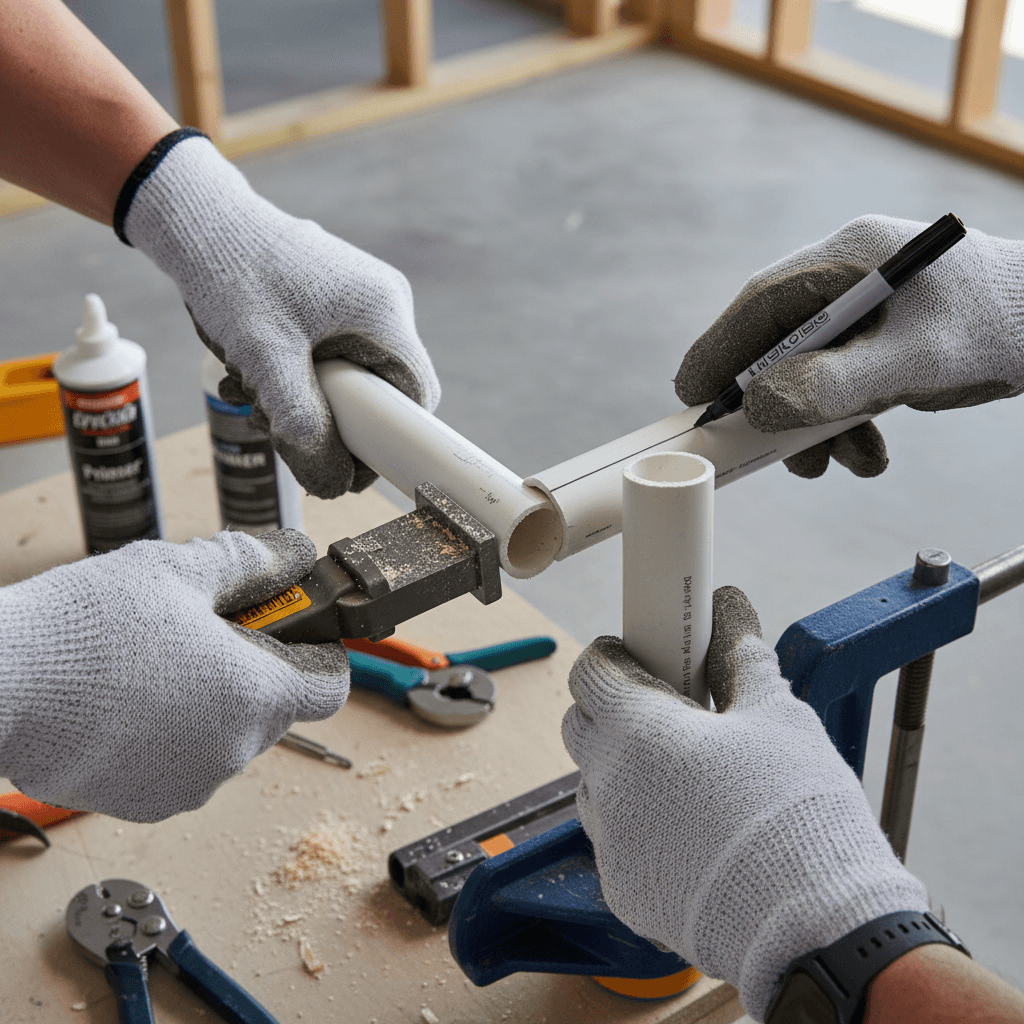
This is a simple method that pros use daily. It’s the Plumber Trick for PVC Pipes that makes joints consistent.
- Bevel the pipe end. A small chamfer lets it slide without wiping off cement.
- Mark the insertion depth. You know you’ve seated fully.
- Quarter‑turn during insertion. It spreads cement evenly.
- Hold the joint. It stops push‑back while the weld grabs.
Do this and you’ll get fewer leaks, cleaner alignment, and less rework.
- Pipe cutter or fine‑tooth saw: straight, square cuts save you time later.
- Deburring tool or bevel tool: aim for a 2–3 mm chamfer at about 15°.
- Solvent cleaner/primer and solvent cement: match to PVC‑U/PVC‑C and follow the brand’s instructions. In the UK, many systems use cleaner plus solvent weld; some require primer.
- Marker pen: a bold witness mark at the socket depth.
- Lint‑free wipes: for cleaning. Avoid fluff in the joint.
- Gloves and eye protection: cement stings; protect your skin and eyes.
Tip: Keep separate brushes for cleaner and cement. A dirty brush ruins the bond.
Step‑By‑Step: Using The Plumber Trick For PVC Pipes
Follow these numbered steps for reliable solvent welds.
-
Measure And Cut Square
Make a straight cut. A square face mates better and avoids gaps. Use a pipe cutter or a fine saw.
-
Deburr And Bevel (2–3 mm At ~15°)
Remove burrs inside and out. Add a small 2–3 mm chamfer. This prevents scraping off cement and reduces push‑back.
-
Dry‑Fit And Mark The Depth
Push the pipe into the fitting dry. Measure the socket depth and mark the pipe. Typical 40 mm sockets are around 30 mm deep; 110 mm soil often 60–70 mm. Always check the fitting.
-
Clean/Prime Both Surfaces (10–20 Seconds)
Wipe the spigot and the socket with solvent cleaner or primer. 10–20 seconds is enough. Let it flash off. Don’t touch the cleaned areas.
-
Apply Solvent Cement: Even, Generous Coat
Brush a full, even coat on the pipe spigot, then a light, even coat in the fitting socket. If the pipe is larger than 63 mm, add a second coat to the pipe.
-
Push Fully And Quarter‑Turn
In one motion, push the pipe to the mark and give a quarter‑turn as you seat it. Align your witness marks if you made them. Don’t over‑twist.
-
Hold Firm For 15–30 Seconds
Maintain pressure so it doesn’t back out. Wipe excess cement. The joint will “grab” quickly.
-
Support And Leave For Initial Set (≈15 Minutes)
Avoid stress for about 15 minutes. Don’t load it. For drain work, many contractors move on after this window.
-
Plan Full Cure Before Pressure (2–24 Hours)
For low‑pressure or DWV, 2–4 hours is commonly safe at mild temperatures. For larger diameters or cold weather, allow up to 24 hours. Always follow the cement label.
-
Check Slope And Alignment
For gravity drains, aim for 6–10 mm fall per metre. Sight along the run. Correct while the cement is still green if needed.
This is the Plumber Trick for PVC Pipes in action. It works on 32 mm waste up to 160 mm soil, with the right cement and timings.
Common Mistakes And Quick Fixes
-
No Bevel = Push‑Back
If you skip the bevel, the pipe can creep out. Fix: cut back, bevel 2–3 mm, and remake with the quarter‑turn.
-
Thin, Patchy Cement
Dry patches lead to weeping joints. Fix: apply a full, even coat to the spigot and a light coat to the socket. Work fast.
-
No Depth Mark
Without a mark, you can under‑seat by 5–10 mm. Fix: always mark the socket depth before cementing.
-
Twisting Too Late
Don’t twist after the cement has grabbed. Fix: push and quarter‑turn in one move.
-
Temperature Issues
Below 5°C, cure slows a lot. Above 35°C, solvent flashes too fast. Fix: warm the materials in cold weather; shade and pre‑fit in heat.
-
Salvage A Tight Spot
Use an inside pipe cutter to remove a spigot from a fitting without cutting back a long run. Then rebuild with a slip/repair coupling.
Adapting The Plumber Trick For PVC Pipes
-
Cold Weather (0–5°C)
Use a fast‑set cement designed for cold. Increase hold time to ~30 seconds. Extend cure toward 24 hours for large sizes.
-
Hot Weather (30–35°C)
Pre‑fit parts, work in shade, and cap tins between joints. Apply cement a touch heavier. Assemble within 5–10 seconds of application.
-
Large Diameters (≥110 mm)
Use a second coat on the pipe spigot. Get a helper to keep the quarter‑turn smooth. Hold longer—up to 45 seconds—so it doesn’t back out.
-
Tight Alignments
Make alignment witness marks before cementing. After the quarter‑turn, line up the marks within 2–3 seconds.
-
Movement And Expansion
On long outside runs, allow for movement. Many contractors allow several millimetres per metre over big temperature swings. Use expansion couplings where needed and support every 1–1.5 m on horizontals.
Pricing, Notes, And Client Sign‑Off
Clear notes stop disputes. Snap quick photos of the bevel and the witness marks before assembly. Log pipe sizes, number of fittings, and cure time windows. This pairs well with clear professional proposals and simple invoice templates. Many contractors capture notes on site and turn them into neat proposals using tools like Donizo. Voice to Proposal is handy when your hands are full and you need to move fast.
Frequently Asked Questions
Do I Always Need Primer On PVC?
Follow the manufacturer. In the UK, many PVC‑U systems use a solvent cleaner plus solvent cement, with no coloured primer. Some brands specify primer for certain sizes or conditions. The Plumber Trick for PVC Pipes works either way—clean properly and apply cement correctly.
How Long Before I Can Test The Line?
Commonly, you can handle after about 15 minutes. For drain/vent work, basic testing is often fine after 2–4 hours at mild temperatures. For large diameters or cold weather, wait up to 24 hours. Always check the cement label and local practice.
What’s The Best Bevel Size?
A 2–3 mm chamfer at roughly 15° is a good target. It’s enough to guide the pipe in without scraping off cement. This small bevel is a core part of the Plumber Trick for PVC Pipes.
Why The Quarter‑Turn?
The quarter‑turn spreads the cement into a uniform layer. It also helps avoid channels and voids that can seep later. It’s a key move in the Plumber Trick for PVC Pipes and takes under 2 seconds.
Can I Use This On Pressure Lines?
Yes, but be strict with cure times, support, and cement selection. Pressure lines often need longer cures, sometimes 24 hours, and correct pressure ratings. The Plumber Trick for PVC Pipes still applies—bevel, mark, quarter‑turn, hold.
Conclusion
Do the basics well and PVC work becomes simple. Bevel 2–3 mm, mark depth, quarter‑turn, and hold 15–30 seconds. That’s the Plumber Trick for PVC Pipes, and it just works. Next steps: 1) Stock a bevel tool and cleaner in every kit. 2) Mark every socket depth before you open the cement. 3) Log cure times on your job sheet. If you like to capture notes and turn them into clean proposals fast, platforms such as Donizo can help with voice capture, e‑signatures, and one‑click invoicing. Put this method to work on your next run and enjoy fewer call‑backs.