Intro
On most jobs, a clean bend saves time, joints, and leaks. A Perfect Copper Pipe Bend Without Kinks is about support, radius, and patience. This guide shows you simple, reliable methods that work on site. We cover lever benders, bending springs, and annealing for tight bends. You’ll learn marking, take‑ups, angle checks, and how to fix small mistakes. Follow these steps and you’ll get smooth curves, true angles, and no crushed pipe. It’s the fast way to tidy runs and fewer fittings.
Quick Answer
To get a Perfect Copper Pipe Bend Without Kinks, support the pipe and keep the radius big enough. Use a lever bender or the right‑size spring, bend in small pulls, and keep the pipe aligned. For tight bends, anneal the copper, then form around a former. Check flattening stays under 10% of the pipe diameter.
Table of Contents
Key Takeaways
- Support the pipe and use a radius of at least 3× OD.
- Mark accurately; allow 15–20 mm take‑up on many 15 mm benders.
- Keep flattening under 10%; angle tolerance within ±2°.
- Anneal for tight bends; let it cool 2–3 minutes before handling.
- A single 90° bend takes 1–2 minutes when marked right.
The right kit makes a Perfect Copper Pipe Bend Without Kinks simple. Keep it clean and matched to your pipe size.
- Pipe: EN 1057 copper, common sizes 10 mm, 15 mm, 22 mm.
- Lever bender with formers and guides for each size.
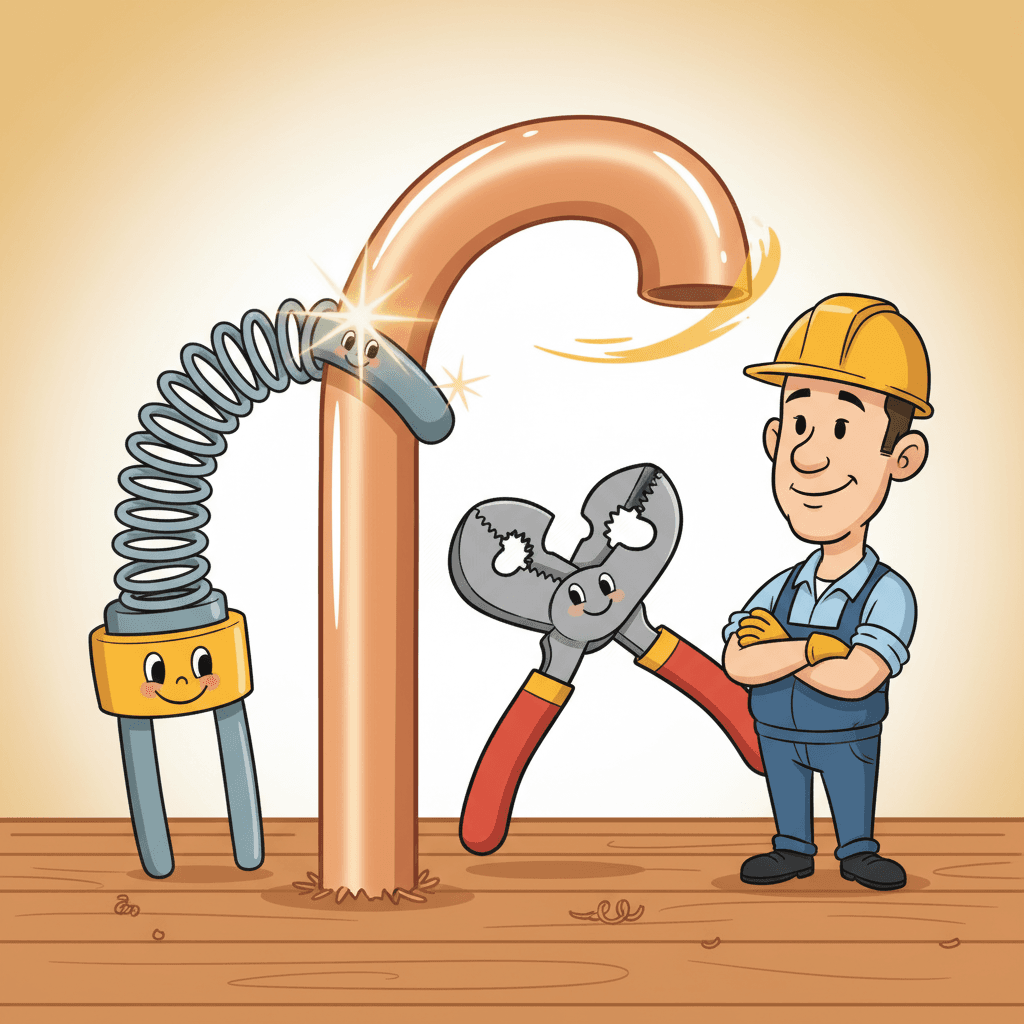
- Bending springs: internal and external, matching pipe size.
- Tape, fine marker, square, ruler, and a small level.
- Deburring tool, file, and 120‑grit emery cloth.
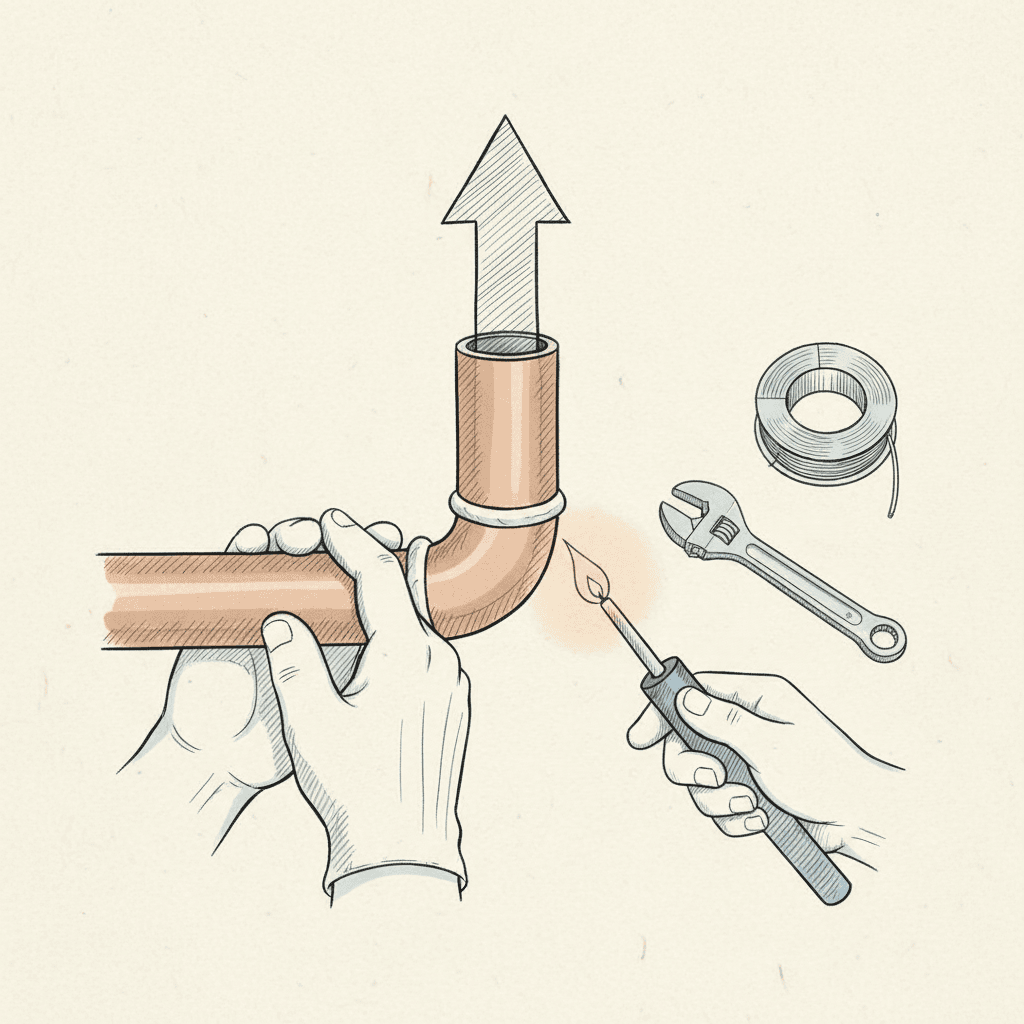
- Optional: blowtorch for annealing, dry fine sand, wooden or steel former.
- PPE: gloves, eye protection, heat‑proof mat if heating.
Set up on stable ground. Clean the pipe. Deburr both ends. Any burr can start a crease.
Planning Bends: Marking, Math, And Time
Good planning prevents rework. It also saves fittings and joints.
- Measure the run. Mark centre‑lines for each bend.
- Radius rule: use at least 3× outside diameter for cold bends. For 15 mm pipe, aim for a 45 mm minimum centre‑line radius.
- Take‑up (offset) on a 90° bend is commonly 15–17 mm for many 15 mm UK benders. In general, check your tool’s chart or do a test bend.
- Mark: show start, centre, and finish with thin lines. Thicker lines lie; use a fine pen.
- Allow for spring‑back. Expect 2–3° spring‑back on cold bends.
- Time: a simple 90° takes 1–2 minutes; a 3‑bend set may take 8–10 minutes when marked well.
Pro tip: If you’re quoting complex runs, include bend counts and labour. This pairs well with understanding pricing strategies and creating professional proposals.
Perfect Copper Pipe Bend Without Kinks With A Lever Bender
A lever bender is the quickest way to a Perfect Copper Pipe Bend Without Kinks on site.
- Align the mark: Place the pipe so the centre‑mark lines with the former’s 90° or angle mark.
- Support: Fit the matching guide shoe. The shoe prevents flattening and kinks.
- First pull: Pull the handles together in a smooth arc. Stop at 5–10° short of your target to check alignment.
- Check plane: Keep the pipe flat in the tool. Any twist will wrinkle the inside wall.
- Finish angle: Bend slightly past target to allow for 2–3° spring‑back.
- Release: Open the bender fully; slide the pipe out. Deburr if needed.
Accuracy checks:
- Angle within ±2° using a protractor or angle finder.
- Flattening under 10% of OD. For 15 mm, minor oval is fine; severe flat means too tight or poor support.
Perfect Copper Pipe Bend Without Kinks Using Springs
Springs are great in tight spots or where the bender won’t fit. They still deliver a Perfect Copper Pipe Bend Without Kinks if you work slowly.
- Choose the right spring: Internal for straight runs; external for near‑end bends. Size must match the pipe.
- Lube lightly: A wipe of washing‑up liquid or light oil helps movement.
- Insert or slide: Push the internal spring past the bend area by 50–70 mm either side. For external, centre it over the bend zone.
- Hand bend on a knee or around a former. Work in small pulls of 5–10°.
- Keep the bend smooth. Don’t jerk. If it feels stiff, relax and re‑set.
- Remove the spring: For internals, twist clockwise as you pull. If stuck, warm the pipe gently, then pull again.
Guideline: With springs, keep radius ≥ 3–4× OD. Tighter than that risks kinks unless you anneal first.
Advanced Bends: Annealing And Packed Sand
For very tight radii or decorative work, heat helps. Use this for one‑off bends or when formers can’t reach.
Annealing Method (Tight, Clean Bends)
- Mark the bend zone. Clean it bright with emery.
- Heat evenly to a dull red. Aim for 400–650°C; don’t melt solder nearby.
- Let it air cool 2–3 minutes or quench in water. Copper softens either way.
- Bend around a wooden or steel former. Keep the radius consistent.
- Re‑anneal if it work‑hardens. Small heat, then continue.
Packed‑Sand Method (Extra Support)
- Tape one end. Fill with dry, fine sand. Tap the pipe to settle it.
- Plug the other end. The packed sand supports the wall.
- Anneal as above, then bend slowly around a former.
- When done, remove plugs and sand. Flush the pipe thoroughly.
Safety notes:
- Keep flames away from joists and cables. Use a heat mat.
- Ventilate. Don’t heat near gas or solvents.
Avoiding Kinks: Checks, Fixes, And Tolerances
Mistakes happen. Here’s how to avoid and correct them.
Common causes of kinks:
- Radius too tight for cold bending.
- Wrong or missing guide shoe/spring.
- Twisting the pipe during the pull.
- Old, work‑hardened pipe. Anneal first.
Preventive tips:
- Use the right former. For 22 mm, never use a 15 mm shoe.
- Clean, deburr, and mark thin. Thick marks shift alignment by 1–2 mm.
- Make test bends on offcuts to learn your bender’s take‑up.
Quick fixes:
- Small flat on the outside? Re‑insert and apply light pressure opposite the flat.
- Minor wrinkle inside? Warm the area and massage gently with the spring fitted.
- Severe kink (fold line visible)? Cut it out. Don’t risk a weak spot.
Quality tolerances to aim for:
- Angle within ±2°.
- Plane alignment within ±1° (eyeball with a small level).
- Ovality under 10% of OD.
- Centre‑line radius ≥ 3× OD for cold bends.
Documentation tip: Recording bend methods in your job notes helps training and pricing. If you’re also looking to manage project timelines effectively, build a simple checklist for bend counts and testing.
FAQ
What is the minimum bend radius for 15 mm copper?
In general, keep the centre‑line radius at or above 3× OD. For 15 mm pipe, that’s about 45 mm. Using a lever bender former usually meets this. If you must go tighter, anneal the pipe and bend around a proper former.
How do I stop the pipe flattening?
Support it. Use the correct guide shoe in a lever bender or the right‑size spring. Bend in small pulls, keep the pipe in plane, and avoid sharp tugs. Check that flattening stays under 10% of the diameter. If it exceeds that, your radius is too tight or support is wrong.
Can I bend hard‑drawn copper without heat?
You can, but it’s tougher and more likely to wrinkle. For smooth bends, anneal the area to dull red, cool for 2–3 minutes, then bend around a former or in a bender. Re‑anneal if it work‑hardens again.
Do I need an internal or external spring?
Use an internal spring for bends in the middle of a run. It supports from inside. Use an external spring near ends or fittings where an internal won’t reach. Match the spring size to the pipe: 10 mm, 15 mm, or 22 mm.
How do I fix a small kink?
If it’s a light flat, re‑insert the pipe in the bender and apply light pressure past the kink. For a minor inside wrinkle, fit a spring, warm the area, and smooth it out. If you see a sharp fold, cut it out and re‑make the section.
Conclusion
A Perfect Copper Pipe Bend Without Kinks comes from support, radius, and steady pulls. Mark cleanly, bend in small steps, and keep flattening under 10%. For tight work, anneal and use a proper former. Next steps:
- Do two test bends on offcuts to learn your bender’s take‑up.
- Build a simple bend checklist for your team.
- Record standard bend times to price jobs faster.
When you’re ready to turn proven methods into clear quotes and faster approvals, tools like Donizo help capture site details by voice and send branded proposals for e‑signature. Keep your pipework neat, your process neat, and your day shorter.